For the Love of Apples
“I’ve put so much work into the property, really put my soul into it. It would be hard to see the place torn down after all that.” – Greg Ostheimer
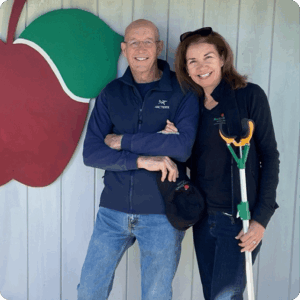
Greg Ostheimer never intended to be a farmer. He was an insurance man from Connecticut, thriving in a word of risk mitigation and predictability. But nearly 25 years ago, he unexpectedly fell in love with apples.
“The insurance business is kind of the antithesis of farming,” laughed the proprietor of Rocky Brook Orchard. “You worry about it being too hot, too cold. You worry about too much rain, about not enough rain. You worry all the time.”
This fall, Greg and his wife Katy agreed to sell the development rights to their farm to Aquidneck Island Land Trust and protect it forever so they don’t have to worry about the future of this special place. If all goes as planned, the conservation easement will close in Spring 2026. A grant from the State of Rhode Island Agricultural Land Preservation Commission will support the easement and the Land Trust is still working with donors on fundraising for the project.
The Ostheimers bought their farm in Middletown, Rhode Island in 1999 – a small parcel, just far enough out of town to be quiet, where they hoped to someday build a home for their young family. And on nearly nine acres of land, there happened to be about 80 apple trees. For a few years, they traveled to the Island on weekends, then one early fall day, wandering the little orchard, they noticed apples carpeting the ground.
“We thought, we can’t just leave them – so we put out a patio table and an umbrella. That’s how it all began,” Ostheimer said.
They bought one advertisement in the local paper, expecting a handful of customers. The first day, they had maybe eight or ten neighbors stop by. The next day, two of them returned, offering hot apple pies as thank you gifts. Within a month of weekends, they had sold out that year’s crop of apples.
“We started to have so much fun. We got to know all our wonderful neighbors and really became part of the community,” Ostheimer said. Time passed and the orchard grew. Now the children from some of that first summer’s customers bring their own families to pick apples.
For a quarter-century, Ostheimer and his family have spent weekends stewarding the orchard, growing it from 80 trees to more than 500 apple, pear, and quince trees. Most orchards in New England offer five or six well-known varieties of apples. Rocky Brook boasts over 100, including a few old-fashioned varieties that they inherited when they bought the property and still haven’t been able to identify.
Both the sheer diversity of the crop and Rocky Brook’s unconventional layout make picking apples here a unique experience. Most small orchards will cluster varieties – a row of Honeycrisp, then a row of McIntosh. But Ostheimer built the orchard piecemeal over many years, taking advantage of a downed tree by planting a few samples of a new variety.
“We don’t have enough real estate to waste on bad apples,” he said.
But if that new variety was delicious – as they so often were – he planted another pocket of it elsewhere when a new gap emerged, resulting in a mosaic of different fruits, from New England classics to heirloom trees to English varieties.
“We started changing the whole business plan and having fun with it,” he said. “We kind of created a monster. Our regular customers come from all over for the unusual, highly flavored apples. People don’t come to us for your typical grocery store apples”
Because the different varieties ripen at different times, he developed an orchard map and a system of color-coded tags cycling through the rainbow from red to blue as early September varieties give way to late-fall fruit that hang on almost until the first frost.
“It was out of necessity, but it makes for a fun experience. People run around through the trees. It’s like a scavenger hunt,” he said.
Over many years, Ostheimer learned about caring for his trees from mentors he met through the Rhode Island Fruit Growers Association. He began to feel the pull of the seasonal rhythms. The hectic rush of springtime, when he fertilizes and trains the fresh new shoots while the bees do their business, bobbing in and out of the heady blossoms.
“When we plant a new tree, it’s basically just a stick in the ground, then as it grows, the branches have a mind of their own,” he said.
Next comes thinning the tiny half-inch apples in the summer to ensure a healthy crop. The exhilarating drum beat of harvest time, as one variety then another comes into full ripeness in turn to delight his customers. Then, in the quiet winter months, his favorite art – pruning and shaping the trees to grow stronger and more resilient in the following year,
“Every tree is different has its own personality – you’ve got to know your trees” he explained. “They’re like your kids. You’re training them to grow up the right way.”
Ostheimer’s own son and daughter are young adults now, building their own lives in other states, and a few years ago, he started thinking about plans for the next phase of his life.
“It’s gotten a little harder for us than it used to be. We started thinking about whether it was time to sell,” he said. “But it’s never really been about the money. If we sell the place, who’s going to buy it? Probably a developer.”
So Greg and Katy started speaking with Aquidneck Island Land Trust, which saw the potential for these acres to connect to other protected farmland, ensuring the long-term survival of both agricultural and wildlife corridors all over the Island.
“Protecting Rocky Brook Orchard is about more than apples – it’s about resilience, community, and the future of our Island. By protecting this farm, we preserve local food, support our economy, and ensure farmland stays farmland forever. We help protect a special place that Aquidneck Islanders and visitors have been going to with their families for decades,” said Alex Chuman, conservation director at the Land Trust.
Now Greg and Katy Ostheimer are making plans to spend their retirement years on this beautiful plot, working the land a little bit every day, knowing that it can remain an orchard.
“It just makes sense, not seeing all my labor demolished,” he said. “This will allow us to continue being a part of and giving back to this community that we love, holding onto the property as long as life allows.”
*If you’d like to make a gift to help protect the orchard, please visit us online or contact Ed Magro at (401) 367-4544 or emagro@ailt.org.


