Resilience, Rooted in Community
“To make change, we need to foster connections – connection to the land, to the water, to community.” – Jamie Haines Matthews, Aquidneck Resilience
Our Island home is facing increased risks from storms, flooding, heat, and other extreme weather events. These challenges are serious, and it can be hard to speak about them without going down a path of doom and gloom. But what if we could flip the script and promote a more optimistic, solution-oriented approach? That is the question Aquidneck Resilience has been seeking to answer as they embarked on their first year of work.
Aquidneck Resilience, an emerging initiative hosted by the Aquidneck Island Land Trust, cultivates hope and creates pockets of joy in their climate work, inspiring those living on Aquidneck Island to take action, together.
Success of the program will look like an Island community that is capable of building resilient systems and implementing solutions that meet people where they are, reflecting the diverse social networks and needs of the Island.
“Climate resilience and social resilience go hand-in-hand,” explains Paige Myatt, Director of Climate Resilience. “We’re building those connections within the community now, before a crisis arises. Our ethos on this project is that resilience work is community work.”
Aquidneck Resilience is a partnership between the City of Newport, the Town of Middletown, the Town of Portsmouth, and Naval Station Newport, hosted by the Aquidneck Island Land Trust. This effort is funded by a $2 million federal grant from the National Oceanic and Atmospheric Administration (NOAA). In 2024, the Land Trust secured this funding with the aim of increasing Island-wide resilience to changing climate conditions, which cause noticeable impacts to Island life, such as increased flooding and water quality issues. The work undertaken by Aquidneck Resilience will help the Island adapt to more frequent and intense weather events, while also elevating its ability to respond to the social and economic impacts of climate change. The solutions to these challenges are often inspired by both social and natural systems. Nature-based solutions, like the installation of rain gardens and restoration of wetlands, are two projects already underway that exemplify these goals.
Aquidneck Resilience focuses on “actionable strategies” – guidance that Myatt has taken to heart since she started building the team one year ago. As of this summer, the program is staffed by a team of five and has recently hired a consultant team, Cascadia Consulting Group, to begin work on the creation of an Aquidneck Island climate resilience plan. To Myatt, this effort isn’t about drafting a plan to sit on a shelf, it’s about building a living, breathing program that represents the needs and the values of this community.
The Launch of Aquidneck Resilience
Aquidneck Resilience officially launched in April of 2025 with an Earth Day Celebration. Hosted at Newport Vineyards, a property conserved by the Land Trust, nearly one hundred attendees showed up to celebrate – a group composed of local organizations, regional coastal resilience practitioners, municipal staff, and community members.
“People have been working separately for far too long. There’s a really strong energy to work more collaboratively,” said Jamie Haines Matthews, Resilience and Sustainability Specialist for the project.
Matthews was one of two staff members hired in the first year of the grant funding period, along with Glennie LeBaron, Community Engagement Manager. The team later brought on two NOAA Coastal Resilience Fellows, Emma Polinsky and Jamie-Lynn Ward – early career professionals who will spend two years supporting the initiative. Polinsky and Ward have brought energy and creativity to their work and provide critical capacity-building needs for the new program. They are supported and mentored by Matthews, LeBaron, and Myatt, who are proud to foster the next generation of climate resilience practitioners.
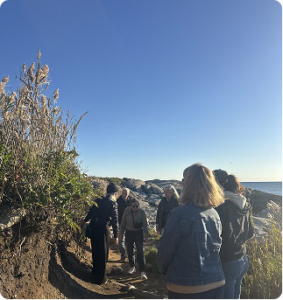
Over the course of this year, the team has built a newsletter and a social media presence, creating content that educates with a fun sense of humor; hosted events across the Island, like strolls on the Cliff Walk to learn about native plants, and a trolley tour of the Island’s rain gardens; and began working groups for coastal resilience practitioners to provide a much-needed forum for collaboration across organizations. The next year promises more events and engagement in friendly places, such as farmer’s markets, parks, and public libraries.
“You need to be where people already are, where they can bring their families … where they feel safe,” said Glennie LeBaron, Community Engagement Manager for the project. LeBaron is focused on making sure that people from all walks of life feel welcome and respected and emphasizes introducing an element of fun to this often serious work.
“If you can foster connections, bringing excitement and optimism to what can be an overwhelming subject, that tonal shift is noticed and appreciated by the public,” LeBaron said.
Resilience Planning
The end goal of all this connection building is a long-lasting, sustainable initiative that can continue to support project implementation and community engagement for critical resilience projects on the Island. The flagship effort of the program is an Island-wide climate resilience plan that will serve as a guiding document, identifying both risks and solutions, creating a list of best practices and prioritized projects that municipal staff, nonprofits, and businesses can all use to make their small piece of the Island more resilient to change.
The groundwork for these efforts was laid by partners long before Aquidneck Resilience began, but the development of the Aquidneck Island climate resilience plan began in earnest with a Fall 2025 community workshop. Now, with support from an expert consulting firm, Cascadia Consulting Group, the team is launching a series of working groups that will help to define challenges, vet solutions, and identify funding opportunities throughout 2026, culminating in a community-driven plan to be released in 2027. The team aims for the plan to be a useful tool for not only municipal staff and other community partners, but an educational resource for Island residents and visitors.
By having a detailed plan in place, various players across the Island can apply for grants or pursue other funding opportunities when they arise; “We can identify all the potentially transformative projects, but if we don’t have the ability to implement them, that can be frustrating. We need to be ready to take advantage of available funds,” Matthews said.
Aquidneck Island isn’t the first locale to take a regional approach to resilience planning, and they are learning from similar communities. The consequences of extreme weather are particularly immediate on an island. “As much as we’re connected to life on the mainland, the bridges sometimes close,” LeBaron recognizes. Visits to learn from coastal resilience practitioners on Martha’s Vineyard, Nantucket, and in Southern Maine have all provided inspiration for the work happening on Aquidneck Island.
Reflections on Aquidneck Resilience’s First Year
The Aquidneck Resilience team has accomplished a lot in its first official months of existence and is excited for what is to come in 2026.
“This has been a very hopeful project for a lot of our collaborators,” LeBaron said.
Even if Aquidneck Resilience doesn’t yet have all the answers, convening those in the region who are asking the same questions and working towards solutions can be empowering, the staff members say.
The proof of concept can be seen in the Almy Pond wetland improvement project. The effort exemplifies that when staff capacity exists to listen to community, while working with experts to develop a solution, we’re able to show meaningful progress. National and global efforts to adapt to climate change may wax and wane, but here on Aquidneck Island, people are head-down, solving local problems, and that’s powerful.
In the coming years, Myatt and the Aquidneck Resilience team hope to support dozens of similar projects across the Island, showcasing what’s possible when solutions are driven by the people impacted the most.
“These kinds of projects are making a real difference, and we have the opportunity to work on them together as one Island,” Myatt said. “This program has become a bright spot in people’s lives. We’ve shown that facing serious challenges can be accomplished with an element of fun, and in the process, we can build a stronger, more resilient community.”


