LINKS
Including the three Aquidneck Island municipalities and Naval Station Newport, nearly two dozen local organizations and individuals lent their support to the grant application, calling for regional collaboration on climate resilience: Aquidneck Community Table, Common Fence Point Association / Preparedness Committee, Eastern Rhode Island Conservation District, Elizabeth Scott, FabNewport, Melissa Welch, Middletown Bike and Pedestrian Advisory Committee, Newport Energy and Environment Commission, Newport Restoration Foundation, Rhode Island Marine Trades Association, RI Department of Environmental Management, RI House of Representatives, Rhode Island Infrastructure Bank, Ride Island (Bike Newport, Grow Smart RI, Toole Design), US Sen. Jack Reed, US Sen. Sheldon Whitehouse, US Rep. Gabe Amo, Sarah Whitehouse, Save The Bay, URI’s Coastal Resources Center/RI Sea Grant, and the van Beuren Charitable Foundation.
NOAA awards Aquidneck Island Land Trust $2 million to grow regional resilience and sustainability efforts
“The climate crisis does not respect municipal boundaries … we are all in this together.” – Lea Hitchen, Town Planner for Portsmouth
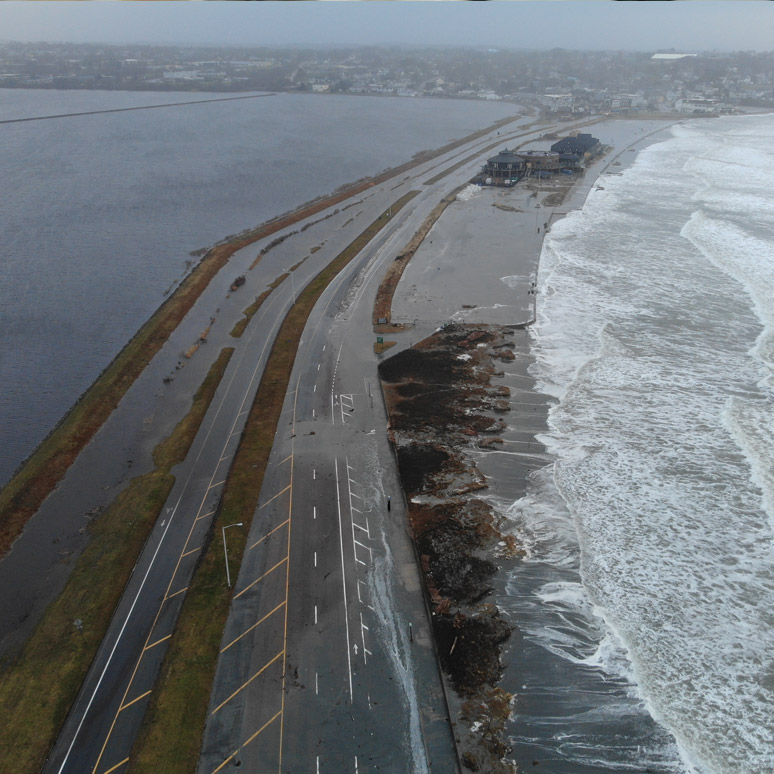
When a series of big Nor’easters rolled in last winter, waves eroded the coastline and rose to historic heights across the region. Roads were flooded, while seawater and salt spray on Easton’s Beach came perilously close to the City of Newport’s drinking water infrastructure as the Atlantic rose.
Examples like this exist all over the Island; aging infrastructure overdue for repair or systems that can no longer meet the communities’ needs and require creative new solutions, explained Paige Myatt, Director of Climate Resilience for the Aquidneck Island Land Trust and project director for the new coordinated resilience project
Ensuring that our infrastructure is climate-ready for the future, across the Island, will take a tremendous investment of time, money, and community collaboration. Now, a new partnership among the municipalities on the Island, the US Navy’s Naval Station Newport, and the Aquidneck Island Land Trust has secured a $2 million federal grant to start moving – together – toward that more resilient future.
Climate resilience in this context means having systems in place to help manage the effects of extreme weather so that our communities can continue to thrive. It’s an issue that faces all of Rhode Island’s coastal communities, Myatt said.
“It would be really hard for any one town to get these things done alone,” she said. “We realize that the capacity to tackle these challenges needs to be multiplied, with a regional perspective to get to the root of these problems. There is a lot of momentum to maintain, and this project allows us to grow the work in a meaningful way.”
The funds come from the National Oceanic and Atmospheric Administration’s (NOAA) Climate Resilience Regional Challenge; a competitive grant program administered by the Office for Coastal Management.
The project was developed in close collaboration with the municipalities of Middletown, Newport, and Portsmouth, as well as Naval Station Newport. Aquidneck Island was one of just 19 grant recipients among 870 communities nationally that expressed interest in the program.
Aquidneck Island Land Trust is proud to serve as the “host organization,” with a role of hiring staff like Myatt to manage the project, facilitating conversations, and sustaining a network to amplify the partners’ individual efforts. Myatt started her new role in October, though she comes to the partnership with several years of experience working toward similar goals in a regional coordination role for the state.
“The Land Trust is proud to partner in service of helping our Island become more resilient to the impacts of a changing climate,” said Terry Sullivan, Executive Director of the Aquidneck Island Land Trust. “We are hopeful that this effort will further a variety of climate resilience projects, particularly efforts that protect and restore our Island’s critical water resources. It has become clear that we must do more to protect these water bodies from stormwater pollution, especially during the big storms that we have been seeing more frequently.”
The task is daunting. The issues are complex, the solutions are expensive, and deep collaboration is hard work. Like all New England’s small towns, communities on Aquidneck Island are proudly independent, taking care of their people for centuries. But there’s also a long history of collaboration across Aquidneck Island, Myatt said.
“We’re all addressing the same challenges,” she said. “Local leaders want to build a broader ethic of thinking about these issues together. Flooding doesn’t reach the town line and just decide to stop. Opportunities multiply when we work together.”
Whether freshwater flooding from large rain events or coastal storm surge, Aquidneck Island faces significant challenges from more frequent and intense hurricanes and tropical storms. Much of the land’s elevation is not far above sea level. The Island is connected to the mainland by a network of bridges. That infrastructure is a liability shared by everyone.
“Work in this area must be grounded in shared values and cooperation,” said Lea Hitchen, Town Planner in Portsmouth. “We are all in this together.”
As future storms become stronger, roads may flood or become so damaged that emergency vehicles can’t get through, people could lose access to schools and social services, drinking water and sewer resources could be threatened. The impacts are myriad and intertwined.
“We’re talking about climate resilience for the natural and built environments – the ability to adapt to a changing climate in the face of increased storms – but social resilience as well,” Myatt said.
A lot of resilience projects have co-benefits that can build a sense of community and make local people’s lives better. For example, repairing a road to address flooding could overlap with making bicycle and pedestrian improvements that boost transportation and recreation opportunities. Similarly, broader adoption of composting programs can divert food waste from landfills, improving soil health, which will, in turn, allow the ground to absorb more rainwater, reducing flooding and improving water quality.
While much of this effort is focused on planning for the future, communities are also implementing specific projects now that fit into that bigger picture.
Community leaders have started learning from other cities and towns facing similar challenges – scattered from Martha’s Vineyard to O’ahu – that have developed innovative solutions for climate resilience.
Starting next year, residents will have opportunities to participate in developing a climate resilience action plan, a detailed strategy and comprehensive list of projects that need to be tackled to prepare Aquidneck Island for a changing climate, which will set up these efforts to be competitive in future funding opportunities.
Local leaders have been thinking about these issues for years and have a long list of potential projects. Collaboration efforts started several years ago, and the communities are excited to build upon that progress to work toward creating a more resilient region, explained Ron Wolanski, Director of Planning and Economic Development for the Town of Middletown.
In the coming year, residents will continue to see resilience efforts progress across the region:
- In Portsmouth, work has begun to reduce flooding on Riverside Street in the low-lying Island Park neighborhood.
- In Middletown, a pump station near Second Beach will be floodproofed.
- In Newport, the city will repair the seawall and implement nature-based solutions to protect against seasonally high tides and storm surge in King Park, with funding provided by a $2.4 million grant from Rhode Island Infrastructure Bank.
The climate resilience action planning will eventually weave together a comprehensive and prioritized list of these types of projects and more, as identified by municipal experts and the broader community.
But the beauty of this program is how it will ensure that a variety of voices are invited to shape the plan. Historically, those most affected by extreme weather have not always been part of planning and developing solutions.
“We need to ensure everyone feels welcome and has a seat at the table,” Myatt said. “We hope this effort allows more people to become involved, providing opportunities for both engagement and education.”
The residents of Aquidneck Island will not feel the impacts of climate change equally. People are facing the same rising tide – both literally and figuratively – but they are meeting that danger with wildly different resources, depending on income, geography, cultural identity, and countless other factors.
“Looking at this collaboratively and though various different lenses is so important,” said
Bari Freeman, founder and Executive Director of Bike Newport. “We need a diversity of people both contributing to and benefiting from climate resilience solutions.”
Freeman has worked on community building through her organization’s Ride Island initiative, as well as the greening urban spaces working group of the Newport Health Equity Zone. The Aquidneck Island Land Trust’s inclusive approach to leadership will be key as partners seek technical assistance and funding, she said.
“The urgency is clear. These are very pressing issues, and the impact and the outcomes are so amplified by coalition,” Freeman said.
Ensuring equitable approaches is an important pillar of Growing Regional Resilience Coordination on Aquidneck Island. The leaders of this effort will ensure that all Islanders – from Common Fence Point to Newport’s North End, to neighborhoods at the southern tip of the Island – are invited into this effort and will share in the benefits of the work.
Moving in concert makes this work more feasible, as towns share knowledge and resources to lower costs by avoiding duplication. Through this grant, Myatt aims to build a web platform to share examples of best practices from around the world, local projects, and resources developed by multiple local, state and national partners. A great deal of useful information exists, but it’s not yet easily accessible in one place, she said.
Cost sharing and avoiding duplication of effort is key, as climate resilience requires significant investment. But there are also steep economic consequences to inaction. Aquidneck Island receives nearly four million visitors each year, with tourists and summer residents spending hundreds of millions of dollars at local businesses.
“Together, we can address projects that will benefit not only our communities, but also the many visitors that enjoy the Island’s scenic and natural beauty, setting an important example for how similar places can tackle these common challenges,” said Patricia Reynolds, Director of Planning and Economic Development for the City of Newport.
And the US Navy – the fourth community on the Island – balances economic and social concerns with issues of national security. More than 3,000 people work at the base, hundreds commute in and out every day, and they must maintain the same municipal infrastructure – roads, water, buildings – as any other community. The impacts of a changing climate can make that daunting for a coastal installation.
“The Navy has recognized the security threat that climate change poses to its military installations around the world,” said Cornelia Mueller, Naval Station Newport’s Community Planning Liaison Officer. “The Naval Station stands ready to support efforts to implement transformative, resilience-building projects that will, no doubt, enhance the military mission now and into the future.”
On a coastal island, climate resilience affects nearly every aspect of life. By coming together for collective action, Aquidneck Island can offer an example to other communities across the world that are facing the same risks.
“These issues are big,” said Myatt. “But we’re all committed to optimism and a solutions-oriented mindset. We very much believe this is the start of something that will last and make a positive impact for generations to come.”
Aquidneck Island
Needs You!
Now more than ever.


